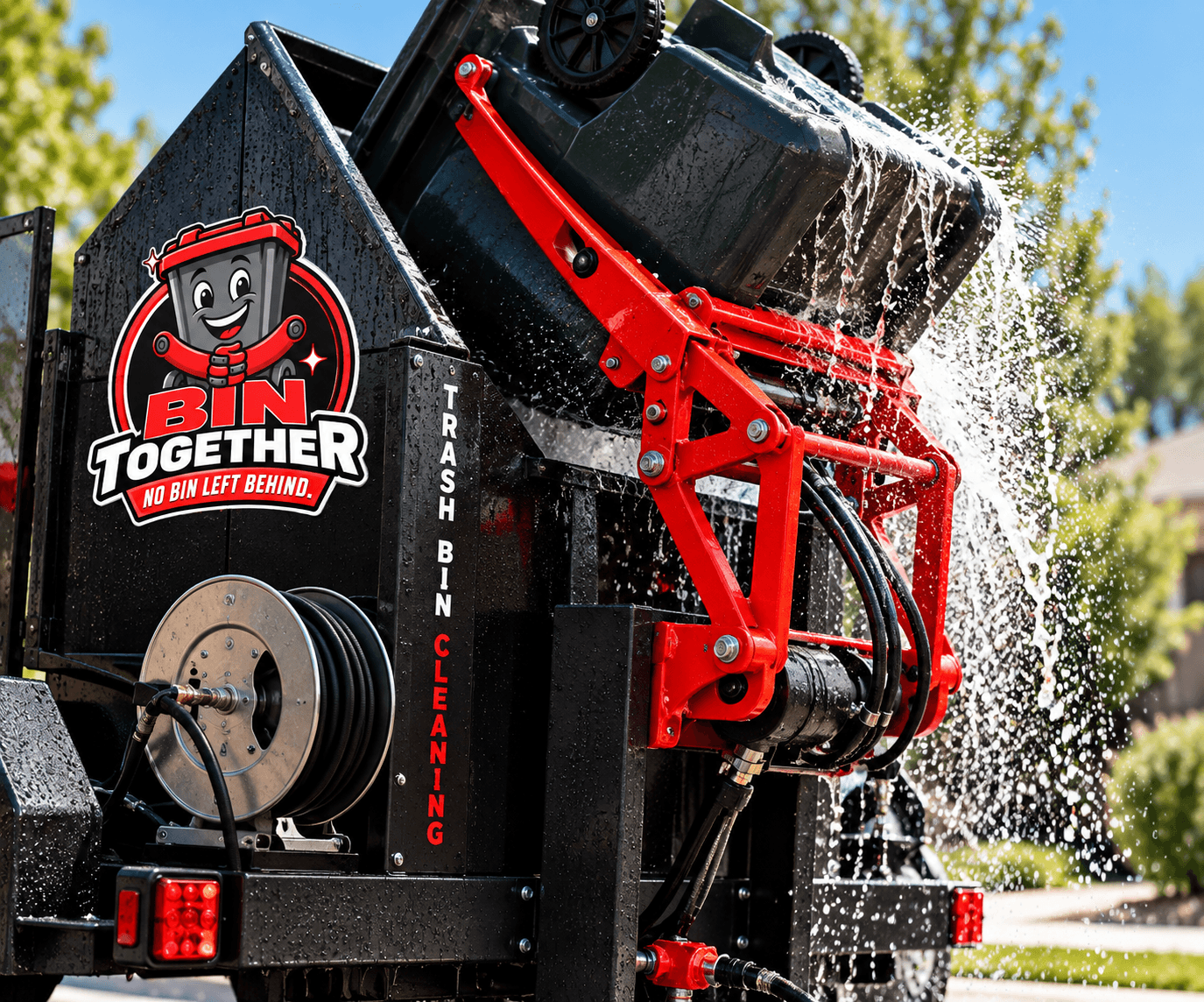
What actually happens when we clean your bin
Not a guy with a garden hose. Here is the whole process, step by step, and how often you actually need it.

4 min read
Most people picture a guy with a garden hose.
That is worth clearing up, because the outside of your bin is not the problem. The outside gets rained on. The inside is where a summer's worth of chicken packaging, dog waste bags, spilled milk and whatever leaked out of the bottom of the bag has been sitting in a sealed black plastic box in Texas heat.
Here is exactly what we do, start to finish.
Before we get there
We come on your normal trash day, after the truck.
That timing is not a convenience, it is the whole system. Your bin has to be empty for us to clean it, and the emptiest it will ever be is right after the city truck tips it. So we run our route behind theirs.
You do nothing differently. You already put your bins at the curb that morning. Leave them there and go to work.
You get a text when we are on the way.
At the curb
1. We check what we're working with. Some bins have a bag stuck to the bottom, or two inches of liquid, or something a raccoon started and did not finish. That changes how long we spend, not what you pay.
2. Loose debris comes out first. Anything solid gets removed and bagged before water touches it. Washing trash down into a tank just makes the tank a trash can.
3. We apply a degreaser and let it sit. This is the step most people skip and it is the one that matters. The film inside a bin is mostly fat and oil from food. Water alone slides right over it. A degreaser has to go on and then be left alone for a few minutes to break that film down. Rushing this is how you get a bin that looks rinsed but still smells.
4. Hot, high pressure wash, inside and out. Heat matters more than pressure here. Hot water dissolves grease that cold water just pushes around. We run it over every interior surface, the lid, the underside of the lid where the worst of it collects, the rim, the wheels and the outside.
5. Deodorizer, last. A clean bin still holds smell in the scratches and scuffs in the plastic. The final treatment goes on after the wash, not instead of it. If a company sprays something fragrant into a dirty bin and calls it done, you will know within four days.
6. Bins go back where they were. Upright, lids closed, roughly where you left them. Not in the street. Not blocking the mailbox.
7. You get an all done text with a photo.
What we take with us
Every drop of the water we use gets recovered into a tank on our trailer. None of it goes into the street, the gutter or the storm drain. That has its own post, because it is the part of this industry most customers never think about.
How long it takes
A couple of minutes per bin once we are set up. You will likely never see us.
That is not us being modest about the work. It is the point of the product. The whole promise is that this becomes something you stop thinking about.
How often is enough?
Honest answer: depends on your house.
Every month is what we recommend and what most families pick. A bin cleaned monthly never gets to the state a quarterly bin reaches by week ten. You are not fixing a problem, you are keeping it from starting. It is also the cheapest option per visit.
Every three months works if your household is small, you bag everything carefully, or you mostly want the smell gone before summer and again before the holidays. Just know that three months is a long time in this climate.
One time is for a move in, a move out, or something specific that happened in there. No judgment. It costs more than four months of the monthly plan, so if there is any chance you will want it again, monthly is the cheaper decision. We would rather say that now than take the $89.99.
Keep reading
More from behind the bin: how we clean, where the water goes, and what we are learning as we build this.